

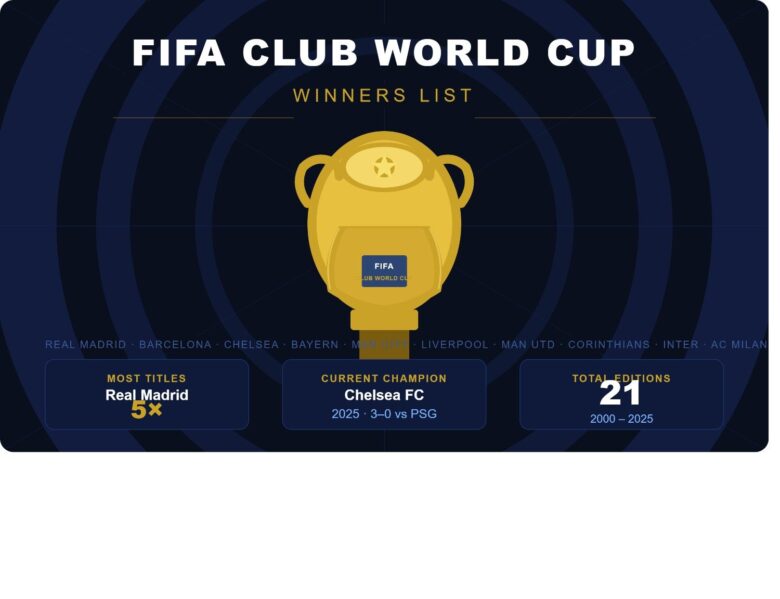
If you’ve ever wondered which club can genuinely call itself the best in the world — not just in Europe or South America, but on the entire planet — the FIFA Club World Cup is where that question gets answered. Since its debut in 2000, the tournament has brought together champions from every corner of the globe, pitting the best of Europe against the pride of South America, Asia, Africa, and beyond. The results have been dramatic, surprising, and occasionally jaw-dropping.
This article walks you through the complete FIFA Club World Cup winners list, year by year, along with the clubs that have dominated the competition, the records that have been broken, and everything you need to know about the tournament’s evolution from a seven-team December spectacle to a 32-nation summer extravaganza.
What Is the FIFA Club World Cup?
Before we get into the winners, a bit of context is useful. The FIFA Club World Cup is an international club football competition organized by FIFA — football’s global governing body. It brings together the reigning continental champions from all six of FIFA’s confederations: UEFA (Europe), CONMEBOL (South America), AFC (Asia), CAF (Africa), CONCACAF (North and Central America), and OFC (Oceania).
The idea is simple but powerful: determine which club team is the best on Earth. The format has changed over the years, but the goal has always remained the same.
The tournament was first held in 2000 under the name FIFA Club World Championship, then suspended due to financial difficulties, and relaunched in 2005. From 2005 onwards, it ran annually, typically in December. In 2025, FIFA completely overhauled the format — expanding it to 32 teams and moving it to a summer window, making it feel far closer to a proper World Cup for clubs.
Complete FIFA Club World Cup Winners List (2000–2025)
Here is every edition of the FIFA Club World Cup, the champion, the runner-up, and the final score:
| Year | Champion | Score | Runner-Up |
|---|---|---|---|
| 2025 | Chelsea | 3–0 | PSG |
| 2023 | Manchester City | 4–0 | Fluminense |
| 2022 | Real Madrid | 5–3 | Al-Hilal |
| 2021 | Chelsea | 2–1 (AET) | Palmeiras |
| 2020 | Bayern Munich | 1–0 | Tigres UANL |
| 2019 | Liverpool | 1–0 (AET) | Flamengo |
| 2018 | Real Madrid | 4–1 | Al-Ain |
| 2017 | Real Madrid | 1–0 | Grêmio |
| 2016 | Real Madrid | 4–2 (AET) | Kashima Antlers |
| 2015 | Barcelona | 3–0 | River Plate |
| 2014 | Real Madrid | 2–0 | San Lorenzo |
| 2013 | Bayern Munich | 2–0 | Raja Casablanca |
| 2012 | Corinthians | 1–0 | Chelsea |
| 2011 | Barcelona | 4–0 | Santos |
| 2010 | Inter Milan | 3–0 | TP Mazembe |
| 2009 | Barcelona | 2–1 (AET) | Estudiantes |
| 2008 | Manchester United | 1–0 | LDU Quito |
| 2007 | AC Milan | 4–2 | Boca Juniors |
| 2006 | Internacional | 1–0 | Barcelona |
| 2005 | São Paulo | 1–0 | Liverpool |
| 2000 | Corinthians | 0–0 (4–3 pens) | Vasco da Gama |
Note: No tournament was held from 2001 to 2004 due to financial difficulties at FIFA. The 2024 edition was also skipped as FIFA prepared for the expanded 32-team format. In its place, FIFA held the Intercontinental Cup in 2024, which was won by Real Madrid.
Most Successful Clubs in FIFA Club World Cup History
Some clubs have treated this tournament like their personal trophy cabinet. Here’s the breakdown of the most decorated sides:
| Club | Titles | Years |
|---|---|---|
| Real Madrid | 5 | 2014, 2016, 2017, 2018, 2022 |
| Barcelona | 3 | 2009, 2011, 2015 |
| Bayern Munich | 2 | 2013, 2020 |
| Chelsea | 2 | 2021, 2025 |
| Corinthians | 2 | 2000, 2012 |
| Manchester City | 1 | 2023 |
| Manchester United | 1 | 2008 |
| Liverpool | 1 | 2019 |
| Inter Milan | 1 | 2010 |
| AC Milan | 1 | 2007 |
| Internacional | 1 | 2006 |
| São Paulo | 1 | 2005 |
Spain leads all nations in combined titles, with Real Madrid and Barcelona accounting for eight trophies between them. That’s a remarkable display of Spanish club dominance in the global arena.
The 2025 FIFA Club World Cup: A Historic New Chapter
The 2025 edition was unlike anything the tournament had ever seen before. For the first time, the FIFA Club World Cup featured 32 teams from all six confederations, played across the United States from June 14 to July 13, 2025. It was essentially FIFA’s version of a Club World Cup in the truest sense — a month-long tournament with group stages, knockouts, and a spectacular final.
And the final delivered.
Chelsea defeated PSG 3–0 at MetLife Stadium in East Rutherford, New Jersey, in front of an attendance of 81,118 fans. The night belonged entirely to Cole Palmer, the 23-year-old English midfielder who scored twice and provided the assist for Chelsea’s third goal.
Palmer’s opening goal came in the 22nd minute after a sharp counter-attack, with Malo Gusto’s initial effort being blocked before the ball fell to Palmer to finish calmly. He struck again in the 30th minute, this time cutting inside two PSG defenders and drilling the ball into the bottom corner. João Pedro then sealed the victory in the 43rd minute, finishing a perfectly-weighted through ball from Palmer into the top right corner.
PSG — the newly crowned UEFA Champions League winners — simply couldn’t cope. Their goalkeeper Gianluigi Donnarumma was beaten three times in a devastating 43-minute spell. PSG’s frustration showed late in the game when Joao Neves was sent off for a red card offence, and the final whistle confirmed what everyone in the stadium already knew: Chelsea were world champions.
It was Chelsea’s second Club World Cup title, having previously won in 2021 under Thomas Tuchel. This time, manager Enzo Maresca guided them to the crown, and Palmer was rightly named the best player of the final.
Chelsea also finished as the tournament’s top scorers with 17 goals — one more than PSG, Manchester City, and Bayern Munich, who all ended on 16.
Key Moments and Records in Club World Cup History
Real Madrid’s Dynasty (2014–2022)
No story in Club World Cup history is more dominant than Real Madrid’s. Between 2014 and 2022, they won the title five times in nine years — a level of consistency that no other club has come close to matching. Their peak run saw them win in 2016, 2017, and 2018 in three consecutive years. The 2022 final was particularly entertaining — a 5–3 thriller against Al-Hilal that stands as the highest-scoring final in the tournament’s history.
Much of this success coincided with Cristiano Ronaldo’s time at the club. Ronaldo has won the Club World Cup four times in total — once with Manchester United in 2008 and three times with Real Madrid (2014, 2016, 2017), making him one of the most decorated players in the competition’s history.
Lionel Messi, on the other hand, claimed the trophy three times with Barcelona (2009, 2011, 2015), completing the great rivalry’s extension into the global stage.
The 2009 Final: Messi and Barcelona’s First
The 2009 final in Abu Dhabi saw Barcelona edge past Estudiantes of Argentina 2–1 in extra time. It was a tense, compact game that required Pedro’s goal in the 110th minute to secure the trophy. For Pep Guardiola’s Barcelona — already Liga and Champions League winners that year — it was the cherry on top of a historic treble-winning season.
The 2012 Upset: Corinthians Beat Chelsea
Before Chelsea were champions, they were runners-up. And in 2012, it was a Brazilian club that denied them. Corinthians defeated Chelsea 1–0 in the final, with a lone goal from Paolo Guerrero enough to bring the trophy home to São Paulo. It was a memorable David-vs-Goliath moment in many ways — a club competing on pure heart and unity against one of Europe’s financial heavyweights.
Manchester City’s Treble Capstone (2023)
When Manchester City lifted the Club World Cup in 2023, defeating Fluminense 4–0, it was the final piece of one of the greatest seasons any club has ever produced. That year, City won the Premier League, FA Cup, UEFA Champions League, UEFA Super Cup, and the Club World Cup — five trophies in a single calendar year. It was football history in motion, and Pep Guardiola’s side made it look almost routine with a dominant display against the Brazilian champions.
2006: When South America Stunned Europe
One of the competition’s most eye-opening results came in 2006 when Brazilian side Internacional defeated Barcelona 1–0 in the final. This was a star-studded Barça side, too — featuring Ronaldinho, Deco, and a very young Messi. Internacional, making their first and only appearance in the final, held on for a historic victory that reminded the world that South American football could still match European quality on neutral ground.
The Tournament’s Evolution: From 7 Teams to 32
When the Club World Cup relaunched in 2005, it had a simple seven-team format: the Champions League winner plus the continental champions from the five other confederations, plus the host nation’s representative. It was compact, relatively low-key, and usually wrapped up in about a week.
For years, critics argued the format was too small and too predictable. European clubs dominated so thoroughly that it started to feel less like a genuine world championship and more like an exhibition. Something had to change.
In 2025, FIFA finally acted. The expanded 32-team format brought in multiple clubs from UEFA and CONMEBOL — the two strongest confederations — along with more representatives from other regions. The tournament moved to summer to avoid clashing with domestic league calendars and was given the full World Cup treatment, complete with a proper group stage, round of 16, quarterfinals, semifinals, and a grand final.
The result was a genuinely thrilling competition that captured global attention. The United States, which is also set to host the FIFA World Cup in 2026, provided excellent host venues, and the MetLife Stadium final drew a capacity crowd.
Nations Represented in FIFA Club World Cup Finals
While European clubs have dominated, South American clubs have been fierce competitors throughout the tournament’s history. Here’s a look at how different nations have represented themselves in finals:
- Spain – 8 titles (Real Madrid × 5, Barcelona × 3)
- England – 4 titles (Chelsea × 2, Manchester United × 1, Manchester City × 1, Liverpool × 1)
- Germany – 2 titles (Bayern Munich × 2)
- Brazil – 3 titles (Corinthians × 2, Internacional × 1, São Paulo × 1)
- Italy – 2 titles (AC Milan × 1, Inter Milan × 1)
Final Thoughts
The FIFA Club World Cup has grown from a modest global experiment into one of football’s most anticipated tournaments. What started with Corinthians lifting the inaugural trophy in 2000 has evolved into a 32-team competition that now genuinely feels like a world championship for club football.
Real Madrid remains the gold standard, but Chelsea’s dominant 2025 performance — built around the brilliance of Cole Palmer — showed that the tournament’s future is wide open. With the expanded format now firmly in place and the 2026 edition likely to build on the excitement of 2025, there’s never been a better time to follow the competition.
Whether you’re keeping tabs on the winners list for trivia nights, fantasy football research, or sheer love of the game, one thing is clear: the FIFA Club World Cup is no longer just a footnote in the football calendar. It’s becoming one of the main events.
Frequently Asked Questions
Real Madrid, with five titles (2014, 2016, 2017, 2018, 2022).
Spain, with eight total titles between Real Madrid (5) and Barcelona (3).
Chelsea defeated PSG 3–0 in the final at MetLife Stadium, New Jersey, on July 13, 2025.
Cristiano Ronaldo has won it four times (once with Manchester United, three times with Real Madrid).
No. FIFA paused the tournament in 2024 to prepare for the expanded 32-team format. The FIFA Intercontinental Cup was held in its place and was won by Real Madrid.
The 2022 final between Real Madrid and Al-Hilal, which ended 5–3, is the highest-scoring final in the tournament’s history.